
Quick Answer:
Adding more phosphorus to cannabis plants doesn’t always lead to bigger buds or higher potency. A 2025 study found that increasing phosphorus levels had little to no effect on flower yields or cannabinoids. The findings show that once plants receive enough phosphorus, adding more fertilizer may offer little benefit.
If you’ve grown cannabis before, you might have heard that giving your plants more phosphorus during the flowering stage will produce bigger and heavier buds. That’s why so many bloom fertilizers contain high amounts of it.
But researchers are starting to question whether or not all of that extra fertilizer makes much difference. A 2025 study from Utah State University found that cannabis plants given relatively low amounts of phosphorus produced just as much flower as those receiving much more.
So, are you spending money on nutrients your plants don’t really need?
Key Takeaways
The research challenges some common ideas about cannabis feeding, particularly during flowering. Here are the most useful findings for growers.
- Increasing phosphorus didn’t improve flower yields or cannabinoid levels in the variety tested.
- Doubling overall fertilizer strength also failed to produce bigger harvests.
- Cannabis plants absorbed extra phosphorus, even when they didn’t need it for additional growth.
- Higher fertilizer levels caused unused nutrients to build up around the roots.
- Other studies show that phosphorus needs can vary depending on the strain and growing conditions.
Why Is Phosphorus Important for Cannabis?
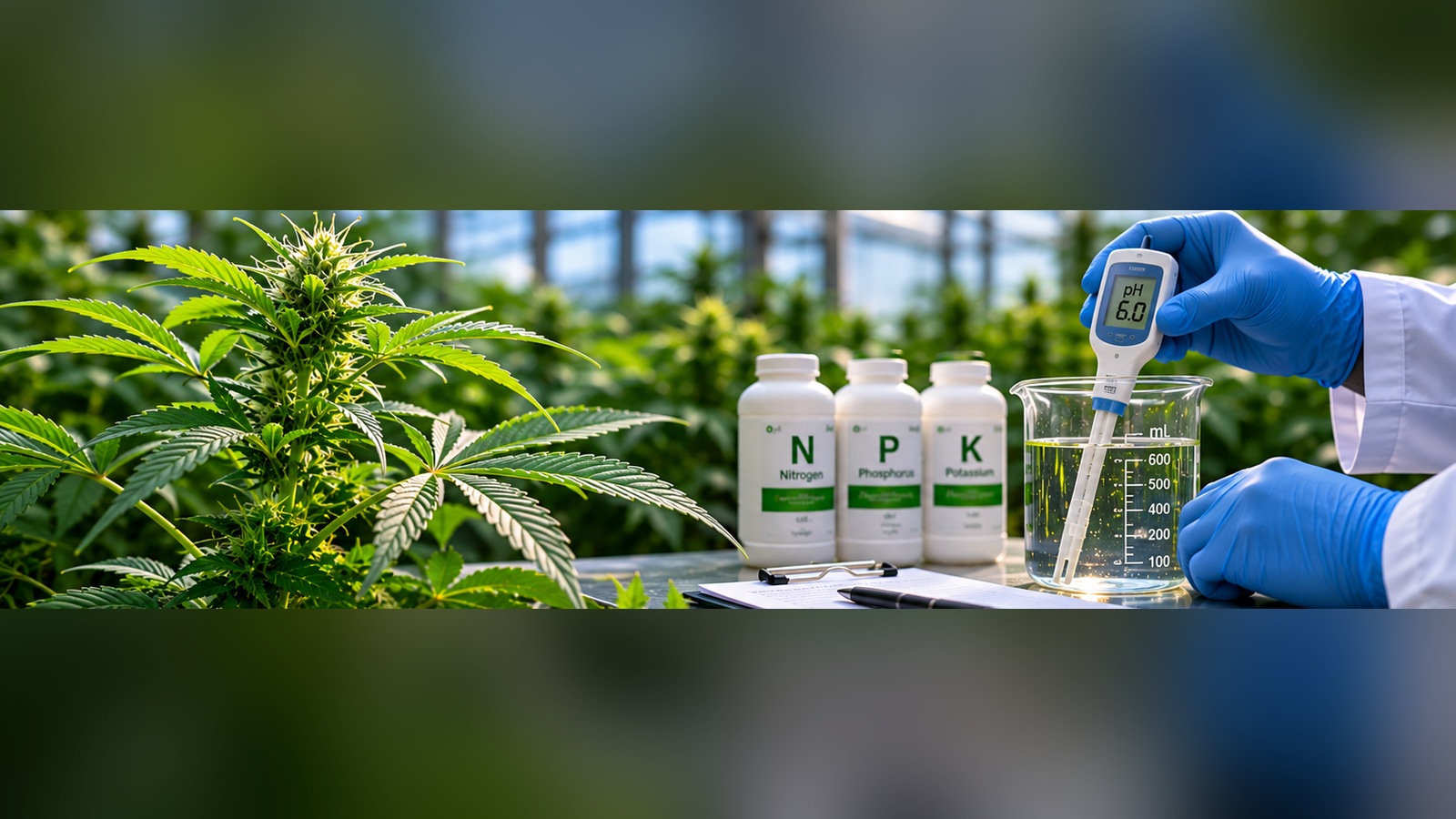
Phosphorus is one of the three main nutrients cannabis plants need to grow big and strong. You’ll generally see it listed alongside nitrogen and potassium on fertilizer labels as NPK.
These nutrients each have different jobs, and all three contribute to healthy growth.
| Nutrient | Main Role |
|---|---|
| Nitrogen (N) | Supports healthy leaves and stems |
| Phosphorus (P) | Helps roots, energy production, and flowering |
| Potassium (K) | Helps plants manage water and supports growth |
Phosphorus helps plants use energy and develop flowers, which explains why it’s associated with bigger buds. But, there’s a difference between giving plants enough phosphorus and way too much.
What Did the Researchers Test?
In February 2025, researchers from Utah State University looked at how phosphorus and fertilizer strength affect cannabis growth. The researchers grew a high-CBD, low-THC variety called T1 in a controlled hydroponic system. They wanted to find out if increasing nutrients would lead to larger harvests or higher cannabinoid levels.
The researchers ran two sequential hydroponic trials with T1 cannabis. Each trial tested three phosphorus levels at EC 2.0 and EC 4.0: 30, 60, and 90 ppm in the first trial, and 15, 30, and 45 ppm in the second. The shared 30 ppm treatment allowed the results to be normalized and analyzed across the two trials. If you’re not familiar with EC, it’s simply a way of estimating the amount of dissolved fertilizer in water.
What Did the Study Find?
After 8 weeks the study produced some interesting results. Although the plants received very different amounts of fertilizer, their final harvests were quite similar.
1. More Phosphorus Didn’t Produce Bigger Buds
The researchers increased phosphorus from 15 to 90 ppm, giving some plants six times as much as others. In spite of this difference, flower yields stayed roughly the same.
Even the lowest phosphorus levels provided enough for the plants to grow well under the conditions tested, suggesting that more is not always better.
2. Stronger Fertilizer Didn’t Increase Potency
The researchers also doubled the overall fertilizer strength, expecting it to improve flower production or cannabinoid levels.
That said, the plants given stronger nutrients didn’t produce noticeably better results. Across treatments, total CBD equivalent averaged 13.55%, while total THC equivalent averaged 0.59%.
For growers, this raises an interesting question: why use more fertilizer if it doesn’t improve the harvest?
3. Cannabis Plants Absorbed More Phosphorus Than They Needed
Interesting to note is that even though extra phosphorus didn’t improve yields, the plants continued absorbing it.
When phosphorus levels increased from 15 to 90 ppm, the amount stored in leaves doubled, while flower phosphorus levels rose by 70%. In other words, the plants were storing more nutrients without actually producing more cannabis.
4. Extra Nutrients Built Up Around the Roots
The researchers also found that unused nutrients collected in the water surrounding the roots. At the highest phosphorus amounts, the levels eventually climbed above 300 ppm. Although the plants didn’t show obvious signs of damage, all that extra fertilizer wasn’t helping them produce more buds either.
Why Can Too Much Fertilizer Be a Problem?
You might wonder why excess phosphorus matters if the plants can tolerate it. The main concern is that extra nutrients cost money, can collect around the roots, and may eventually end up in wastewater.
A 2022 study by Westmoreland and Bugbee found that tripling phosphorus didn’t improve cannabis yields or cannabinoid levels at all, but phosphorus leaving the growing containers increased twelvefold. That means growers can save money and reduce fertilizer waste by avoiding nutrients their plants don’t need.
What Do Other Studies Say About Phosphorus for Cannabis?
The Utah State University findings aren’t the only evidence that heavier feeding doesn’t always improve cannabis. Several other studies have reached similar conclusions, although some found that plants need different amounts depending on the variety.
- A 2020 study from North Carolina State University found that increasing phosphorus beyond certain levels didn’t improve cannabinoid concentrations. The selected composite buds had their greatest fresh weight at 22.5 ppm P, which was higher than the two lowest treatments but not significantly different from 11.25, 15, or 30 ppm. Because the study did not measure whole-plant flower yield, it does not show that higher phosphorus increased overall bud production.
- A 2021 study by Shiponi and Bernstein found that too little phosphorus restricted cannabis growth. The researchers also found differences between the two varieties tested, meaning that not every plant has identical needs.
New Research Shows Why Strains and Feeding Levels Matter
Two more studies offer some useful context, especially for growers working with different cannabis varieties.
- A 2021 University of Guelph study tested a high-THC variety called Gelato. In one Gelato trial that varied nitrogen, phosphorus, and potassium together, a response-surface model predicted an optimum near 59 ppm P under that experiment’s soilless conditions. That’s higher than the lowest level used in the Utah State University study, highlighting why one feeding target won’t work for every strain.
- Meanwhile, a 2023 study from the University of Hohenheim found that in a separate whole-fertilizer study—not a phosphorus-only experiment—the 160 mg N/L treatment received one-third less fertilizer than the 240 mg N/L treatment and produced 95% as much total CBD, despite lower inflorescence mass. Flower weight was lower, but the findings show that growers can sometimes reduce fertilizer without losing too much of their total CBD production.
The lesson from these studies is that cannabis needs proper nutrition, but more fertilizer isn’t always better.
What Can Home Growers Learn?
If you’ve been adding extra bloom boosters because you think that more phosphorus means bigger buds, this research might change your mind.
This doesn’t mean you should stop feeding your plants or follow the study’s exact phosphorus levels. It simply means being more careful about how much fertilizer you use.
- Start with balanced nutrients. Use a fertilizer designed for your growing medium and follow its recommended feeding schedule as a starting point.
- Monitor plant health. Watch leaf color, growth, and development rather than just increasing nutrients automatically.
- Check pH and EC. If you’re growing hydroponically, these measurements can help you understand what’s happening around the roots.
- Avoid unnecessary bloom boosters. Adding extra phosphorus will provide little or no benefit if your plants already have enough.
It’s also worth knowing that poor growth isn’t always caused by nutrient shortages. Problems with lighting, watering, temperature, or pH can produce similar symptoms, so check the basics before reaching for more fertilizer.
Final Thoughts on Phosphorus for Cannabis
It’s easy to understand why growers turn to stronger fertilizers when flowering begins. After weeks of caring for your plants, you naturally want to give them everything they need for a great harvest.
But the research suggests that piling on extra phosphorus isn’t necessarily the answer. Once plants have enough, adding more may do little besides increase fertilizer costs and waste.
A better approach is to pay attention to what your plants need, keep feeding levels balanced, and make changes when there’s a reason to. Healthy plants need the right amount of nutrients, and that doesn’t always mean more.
Frequently Asked Questions
Here are answers to a few common questions about phosphorus for cannabis and what the research means for everyday growers.
Does Phosphorus Make Cannabis Buds Bigger?
Phosphorus helps cannabis plants develop flowers, but adding more than they need won’t necessarily produce bigger buds. The 2025 Utah State University study found no clear yield improvement when phosphorus increased from 15 to 90 ppm. Other studies have found different results, so the best amount depends on the variety and growing conditions.
How Much Phosphorus Does Cannabis Need During Flowering?
There’s no single phosphorus level that works for every cannabis plant. In this closed, continuously replenished hydroponic system, 15 ppm P in the refill solution was sufficient for maximum measured yield and cannabinoid production in T1. Other cultivars and root-zone systems may respond differently. Growers should use a suitable feeding program and adjust it based on plant health and growing conditions.
Can Too Much Phosphorus Hurt Cannabis Plants?
Too much phosphorus can contribute to nutrient imbalances and fertilizer buildup. Interestingly, the plants in the Utah State University study tolerated high phosphorus levels without obvious damage, but they didn’t produce larger harvests. Giving plants more fertilizer than necessary can also increase growing costs and waste.
Sources
- Hershkowitz, Westmoreland & Bugbee (2025). Elevated Root-Zone P and Nutrient Concentration Do Not Increase Yield or Cannabinoids in Medical Cannabis. Frontiers in Plant Science.
- Westmoreland & Bugbee (2022). Sustainable Cannabis Nutrition: Elevated Root-Zone Phosphorus Significantly Increases Leachate P and Does Not Improve Yield or Quality. Frontiers in Plant Science.
- Shiponi & Bernstein (2021). The Highs and Lows of P Supply in Medical Cannabis: Effects on Cannabinoids, the Ionome, and Morpho-Physiology. Frontiers in Plant Science.
- Cockson et al. (2020). Impact of Phosphorus on Cannabis sativa Reproduction, Cannabinoids, and Terpenes. Applied Sciences.
- Bevan, Jones & Zheng (2021). Optimisation of Nitrogen, Phosphorus, and Potassium for Soilless Production of Cannabis sativa in the Flowering Stage Using Response Surface Analysis. Frontiers in Plant Science.
- Massuela et al. (2023). Cannabis Hunger Games: Nutrient Stress Induction in Flowering Stage. Frontiers in Plant Science.