
What the science says
So, you’re looking into growing your own cannabis at home for the first time. Maybe you are a keen gardener wanting to grow it as a rewarding hobby, or looking for a reliable, more affordable supply of a specific variety for personal or medical use.
Those initial internet searches can be overwhelming for the would-be beginner, especially for those wanting to grow cannabis indoors.
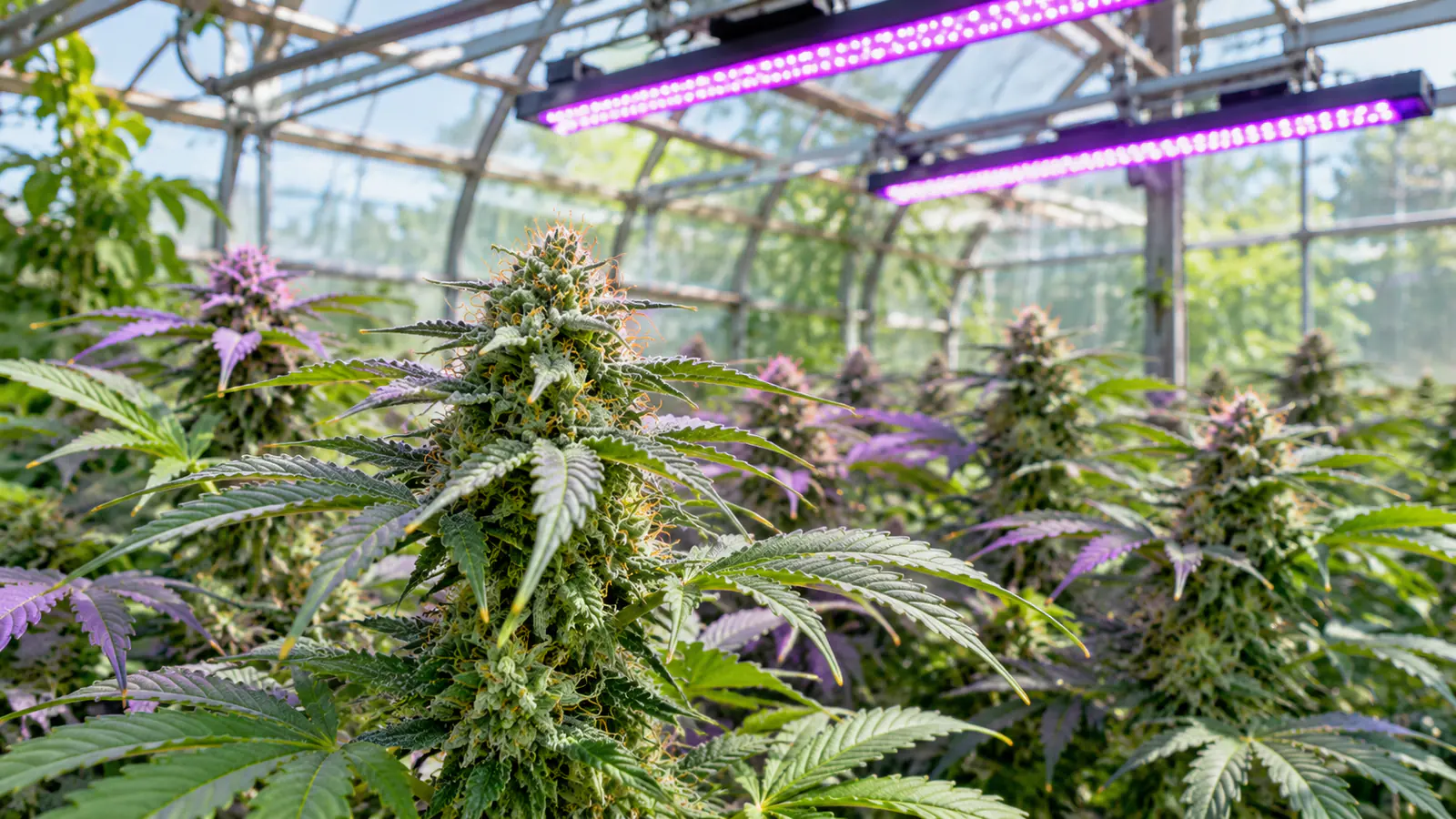
The range of growing gadgets available is vast, from LED grow lights to growing tents and climate control systems. And that is before factoring in the water and electricity costs.
That raises the question of which cannabis growing equipment meaningfully impacts cultivation outcomes, and which are nice to have but not essential for the amateur home grower.
Why do some growers think that UV light increases cannabis potency?
An observation that made some growers prick up their ears was that cannabis plants may increase Δ9-tetrahydrocannabinol (Δ9-THC) production under UV light.
This is relevant because Δ9-THC is one of the most economically important cannabinoids produced by the plants.
Scientists thought that cannabis plants may be doing this for photoprotection, meaning that this was a mechanism by which they were protecting themselves from cellular damage from the UV light, not unlike sunblock use by humans.
This theory originated from research from the 1970s and 80s that showed that cannabis plant populations adapted to being grown in areas with higher UV light levels, such as higher altitudes or lower latitudes, may produce more Δ9-THC.
However, in exploring this, scientists also needed to consider that the female flowerheads of more modern cannabis varieties produce around ten times more Δ9-THC than older varieties did when that prior research was conducted.
In this context, some researchers thought it would be less likely that these newer cannabis varieties would produce more Δ9-THC in response to UV light.
Testing the UV-light theory
Building on these findings, Rodriguez-Morrison et al. (2021) sought to further investigate the effects of UV light on Δ9-THC in cannabis plants, along with flower yields and other cannabinoids, such as CBD. The findings were published in the journal Frontiers in Plant Science.
Cannabis plants from the indoor varieties ‘Low Tide’ and ‘Breaking Wave’ were propagated from cuttings for the study. The rooted cuttings were potted on into 3.79 L pots and then grown on for a further nine days under LED light.
Following this, the plants were transferred to an indoor commercial cannabis growing facility in Ontario, Canada where they were grown in floating polystyrene rafts.
In addition to the normal LED lighting, plants received 3.5 hours of daily UVB exposure from LEDs with a peak wavelength of approximately 287 nm throughout the 60-day flowering trial. The findings are specific to this unusually short UVB wavelength, the tested doses, exposure duration, cultivars, and growing conditions.
In the sixth week, the height and width of each plant was measured. Data was also collected on leaf gas exchange, leaf size, specific leaf weight, yield, and quality during growth and after harvest as appropriate.
What did the researchers find out?
For most of the parameters where UV treatments were applied, the cannabis plants treated with UV from both cultivars had distress-type responses, including limited growth.
This suggests that adding UV light treatment to indoor cannabis plants in commercial cultivation settings may be counterproductive.
The earliest response to UV light treatment was the younger leaves curling upwards, which has previously been observed in some crops such as canola subjected to disease or light-related stress.
UV light also increased the rate of deterioration, known as senescence, in both the foliage and flowerheads. In the plants under higher levels of UV light, browning of the flower stigmas occurred earlier.
Later in the cultivation process, plants with ongoing higher rates of UV light exposure had earlier leaf drop and leaf yellowing and browning from light scorching, known as chlorosis and necrosis, respectively.
The plants exposed to more UVB were also smaller, but total flower-yield responses differed by cultivar. Low Tide’s total dry flower yield declined by about 32% between the lowest and highest UV treatments. Breaking Wave’s total flower yield did not decline significantly, although the dry weight of its uppermost flowers fell as UV exposure increased.
Cannabinoid responses also differed by cultivar. In Low Tide, total equivalent THC and CBD declined as UV exposure increased. Breaking Wave showed an increase in neutral Δ9-THC, but this represented only a small fraction of its total THC potential. Neither cultivar showed an increase in total equivalent THC or CBD from the tested UVB treatments.
Total terpene concentration also declined between the lowest and highest UV treatments—by about 41% in Low Tide and 24% in Breaking Wave. Taken together, the tested short-wavelength UVB treatments provided little evidence of a useful yield or flower-chemistry benefit.
Later or different UV treatments cannot be ruled out by this study, but benefit should not be assumed. A separate 2022 experiment applied UVA plus UVB during the last 20 days of flowering and found no improvement in flower yield or flower cannabinoid concentration under its treatment.
What does this mean for beginner growers?
The tested short-wavelength UVB treatments harmed plant performance and did not increase total equivalent THC or CBD. This is strong evidence against those specific treatments, but the experiment did not evaluate every possible UV wavelength, dose, schedule, or cultivar.
A follow up study by Llewellyn et al. (2022) also published in Frontiers in Plant Science found that UV light had no effect on yield or cannabinoid content.
In this context, investing funds in UV lighting infrastructure likely outweighs the benefit to cannabinoid yields.
UV equipment adds purchase and energy costs and can create skin and eye hazards if exposure is not controlled. Growers should also consider fixture efficiency, durability, cooling, shielding, and safe operating procedures rather than assuming a broad lifespan difference applies to every UVB product.
For beginner growers, this study highlights that you don’t need to spend your precious funds on increasingly complex growing light systems, especially in cases when the science doesn’t identify any meaningful benefit.
For growers cultivating cannabis for their own personal medical use, affordability may be a particularly important consideration.
Growers both new and more experienced can consult the relevant scientific studies in the field to critically evaluate whether the latest growing gadget is worth the investment, or one to add to the list of things they didn’t know they didn’t need.
Why science matters for home gardeners
For beginner cannabis growers, the array of conflicting information, anecdotal advice, and heavily salesy product marketing pitches can be overwhelming, leading them to be doubtful about where to start.
In many cases, often simpler is better, and home growers should consult the scientific literature to evaluate whether a specific horticultural product or process is worth adding to their cultivation toolkit.
One doesn’t need a PhD in plant science to search and read the scientific literature, and the steadily increasing number of open access studies increase the availability of study findings to the public.
However, it is important to also bear in mind that the findings of all research studies have limitations, and they should be read critically with this in mind.
The more you read, the more you will learn, with the knowledge enriching your home gardening experience, whether it be growing cannabis, veggies, fruit, or other plants for their ornamental value.
You don’t need every smart gadget for successful growing, and the science will help you decide what is best for you in your garden and home.
Further reading
Llewellyn D, Golem S, Foley E, Dinka S, Jones AMP and Zheng Y (2022) Indoor grown cannabis yield increased proportionally with light intensity, but ultraviolet radiation did not affect yield or cannabinoid content. Front. Plant Sci. 13:974018.
Rodriguez-Morrison V, Llewellyn D and Zheng Y (2021) Cannabis Inflorescence Yield and Cannabinoid Concentration Are Not Increased With Exposure to Short-Wavelength Ultraviolet-B Radiation. Front. Plant Sci. 12:725078.